Greening the Vertical Plane
Look Straight Ahead.
We landscape the ground. We landscape the roof. What about everything in between?


We landscape the ground. We increasingly landscape the roof. Between them is one of the most abundant and overlooked surfaces in our communities: the vertical plane.
Prepared by Elevation Living Walls for the Metropolitan Mayors Caucus Environment & Energy Committee discussion on Green Roofs and Living Walls.
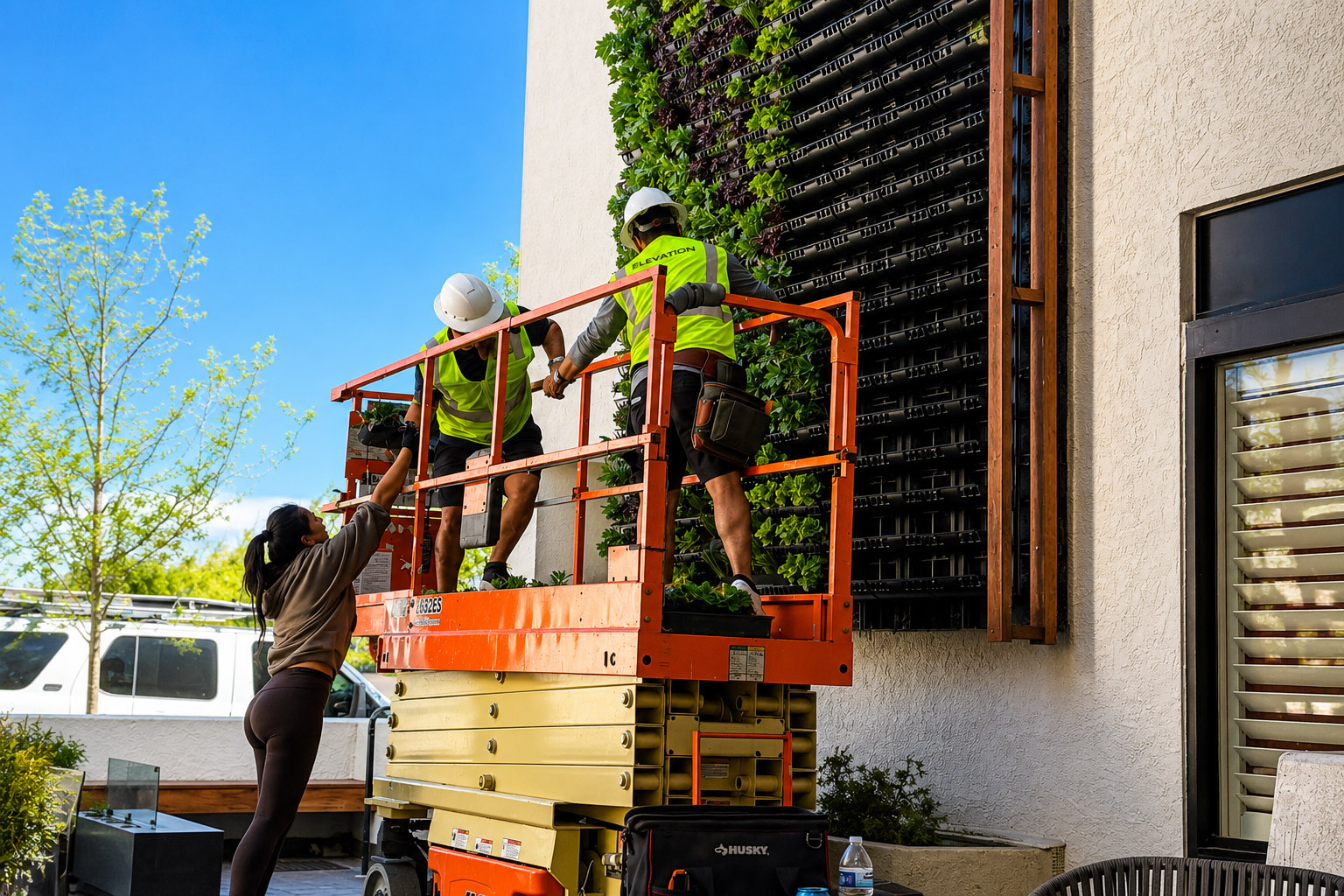
Vertical greening expands the idea of urban green infrastructure beyond parks, trees and green roofs. Living walls, planted façades and other vertical landscapes can help municipalities use existing building surfaces to support biodiversity, pollinator habitat, building performance, water strategies and the human experience of public space.
Across the greater Chicago region, communities may have limited opportunities to add new acreage, but they have enormous amounts of existing vertical surface: village halls, libraries, schools, parking structures, field houses, police stations, transit facilities, water infrastructure, courtyards and commercial buildings.
A six-part framework for looking beyond the ground plane and considering walls, façades and structures as part of a connected regional landscape.
We landscape the ground. We landscape the roof. What about everything in between?
Prefer to watch it as delivered, or read it? This deck follows the talk given to the Metropolitan Mayors Caucus Environment & Energy Committee on September 15, 2026.
“Incorporate vertical greening systems—living walls and green façades—into the community’s sustainable landscaping practices, particularly where ground-level planting area is constrained.”
“Integrate vegetated vertical systems into building water strategies—connecting roof capture, cistern storage and irrigation—as an additional built system supporting stormwater management and water reuse.”
A living wall should not be viewed as a substitute for parks, trees, native landscapes or green roofs. Its greatest regional value may come from helping connect those systems.
Research on Chicago green roofs has documented native bees using rooftop habitat and found that bee abundance and species richness increased with greater surrounding green space. The lesson is not that one wall or roof solves biodiversity. It is that the surrounding network matters.
In sequence, planted ground, walls and roofs can become a connected network of ecological stepping stones.
Vertical greening can support pollinator activity and biodiversity, but ecological performance depends on plant selection, flowering availability, site conditions and the relationship between the wall and the landscape around it.
Greater plant richness can create more varied forage, structure and seasonal value than a visually uniform palette.
A sequence of flowering periods can provide resources across more of the growing season rather than at one moment in time.
Flower availability and species selection influence whether vertical planting provides meaningful resources to insects.
Irrigation and drainage must support plant health without turning a sustainability feature into an unreliable system.
Light, wind, heat, winter exposure and reflected conditions determine which plant communities are appropriate.
The strongest opportunity may be where vertical vegetation connects or complements nearby green infrastructure.
The case for vertical green infrastructure is strongest when a surface contributes to several project objectives at once—not when it is treated as an isolated decorative feature.
Diverse planting can add vegetation and potentially expand pollinator resources within heavily built environments.
Vegetation can shade portions of a building façade and reduce direct solar exposure to exterior surfaces.
Plant and water processes can contribute to localized thermal effects as part of a broader heat-management strategy.
Where technically appropriate, captured water can be considered as part of irrigation strategies connecting roof, wall and ground-level landscapes.
Depending on system design and climate, vertical vegetation may contribute to façade shading and building thermal performance.
Green infrastructure that people can see and experience can make sustainability tangible in civic and community spaces.
Vertical greening in northeastern Illinois must respond to the same realities as every other successful landscape system: winter, wind, freeze-thaw cycles, summer heat, road salt, variable light, water management and access for maintenance.
January does not care about our design intent.
A sustainable project is not the one that looks great when the ribbon is cut. It is the one still thriving in year ten.
"The opportunity is bigger than any single wall system. The real value is in treating vertical surfaces as usable landscape—and designing them to perform over time."
The opportunity does not require a new mandate or a new municipal program. It begins by explicitly recognizing vertical surfaces as another place communities may evaluate when planning green infrastructure.
Not a mandate.
A surface worth counting.
Expand municipal green-infrastructure planning to consider suitable vertical surfaces as opportunities for ecosystem services, biodiversity, climate resilience and community experience.
Two existing strategies already reach toward this. Strategy L30 (Land) asks communities to “increase the quality and amount of sustainable landscaping in the community.” Strategy W29 (Water — already an advanced strategy) asks communities to “optimize the use of natural and built systems to manage stormwater.” Neither names vertical surfaces yet. Both already have the room.
Vertical greening is an emerging field with a growing body of research. The strongest approach is to separate what is demonstrated from what is merely possible and design each project around measurable objectives.
Research documenting native bee use of Chicago green roofs and the relationship between bee communities and surrounding green space.
Vertical Greening · Pollinators Vertical and Horizontal PlantingsExperimental comparison examining pollinator visitation to vertical and horizontal plantings.
Green Walls · Biodiversity Plant Diversity and Flower Cover as Drivers of Pollinator AbundanceResearch examining relationships among plant richness, floral cover and pollinator groups in vertical greening systems.
U.S. EPA · Green Infrastructure Environmental Benefits of Green InfrastructureFederal background on the environmental functions and benefits associated with green infrastructure strategies.
U.S. EPA · Heat Green Infrastructure and Urban HeatEPA guidance on the relationship between vegetation, green infrastructure and strategies for reducing heat-island impacts.
Building Performance Green Wall Thermal Performance ReviewA systematic review examining the thermal-performance evidence associated with green wall systems.
The next piece of public landscape may already exist. It may be the wall nobody thought of as landscape—a surface that can help make our communities more connected, biodiverse, resilient and human.

"Connecting People, Plants, and the Communities that surround us...Vertically"
Copyright © Orange County, California. All rights reserved.